Explained
What is a skatemill?
A skatemill (hockey skating treadmill) is a training machine with a moving deck of synthetic ice or slats on which a player skates in place, in their own skates, while speed and incline are set precisely. Most skatemills pair the deck with a safety harness and video, so coaches can train and analyse the skating stride year-round, independent of ice time.
- Published top speeds of current skating treadmills range from 28 to 35 km/h (17 to 22 mph).
- Decks are either synthetic ice (the HST, Potent) or synthetic slats on a belt (Woodway, Ozo NA spec).
- Incline is stated in degrees by some makers and in percent grade by others.
- Typical buyers are hockey centres, clubs, federations and performance centres, not homes.
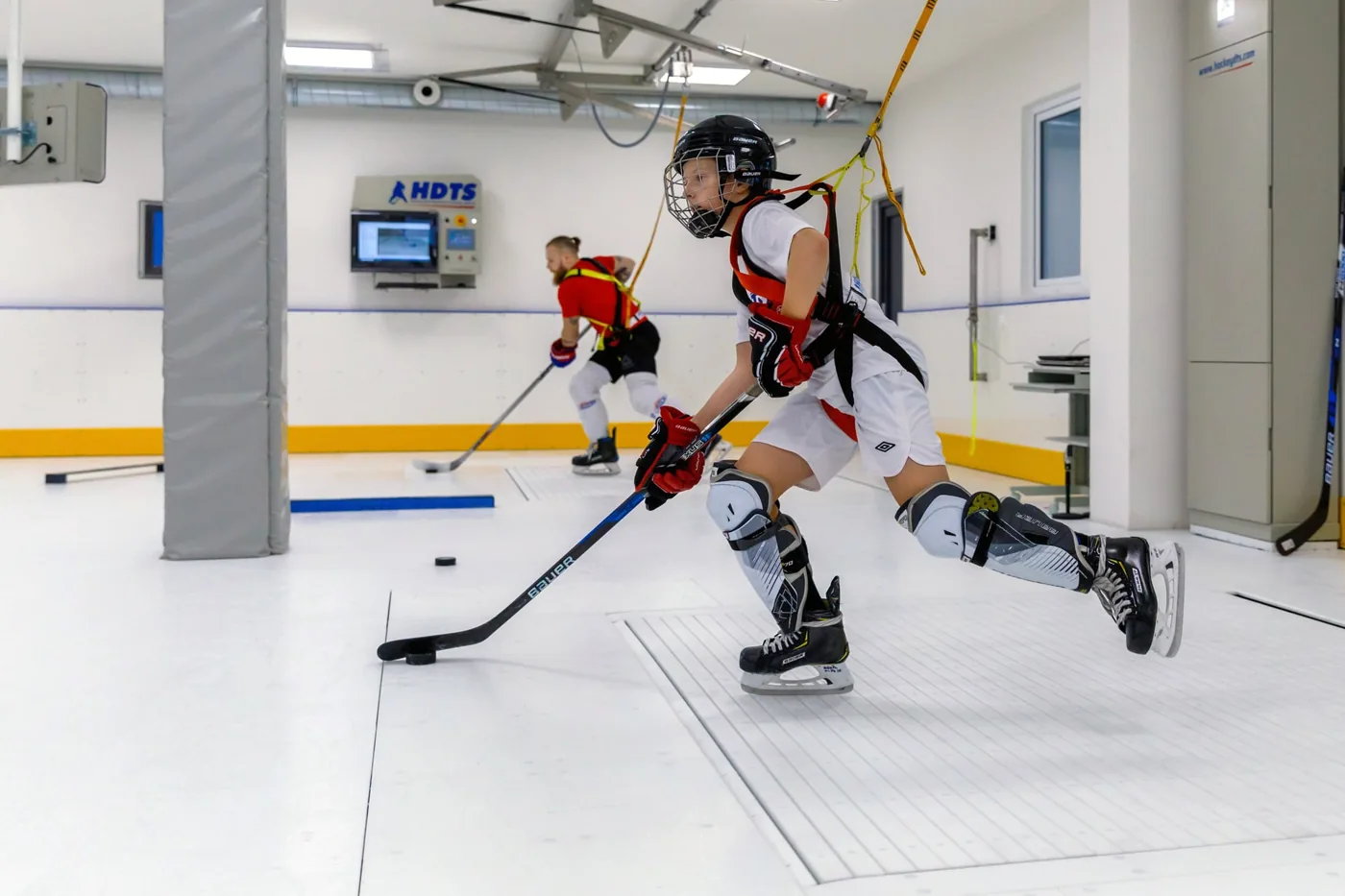
How does a skatemill work?
A motor drives the deck towards the player, who skates against it to stay in place. The coach sets speed and, on models with incline, the deck angle. A harness from the ceiling or a frame catches the player on a fall. Cameras in front and at the side record the stride, so it can be replayed instantly or graded by analysis software.
Skatemill vs. skating on ice
A skatemill does not replace ice time. It isolates the stride: the player stays in one spot in front of the coach and the cameras, at a set speed and incline, for as long as the drill needs. That makes mechanics such as push-off angle, stride length and edge control easier to correct than mid-game. On ice, players add what a skatemill cannot: game situations, turns, stops and play with teammates. Most programs use both.
Who uses a skatemill?
Hockey centres and academies use skatemills to coach many players with the same method; pro and semi-pro clubs use them for year-round skating and load control; federations use them for comparable diagnostics. Machines with ceiling harnesses and 3-phase power are built for facilities, not for home use.
Glossary
- Skatemill / skating treadmill
- Treadmill built for skating in skates. Also called hockey skating treadmill or skating treadmill; HDTS calls its model the HST (Hockey Skating Treadmill).
- Synthetic ice
- Polymer surface skates can glide on. On the HST it forms the deck itself, so the player skates on the same kind of surface as on a synthetic-ice pad.
- Slat belt
- Belt made of individual slats, often UHMW plastic, that run over rollers. It feels different from a continuous synthetic-ice deck and may need lubrication.
- Incline (degrees vs. percent grade)
- Deck angle. Makers state it either in degrees or in percent grade; 10 percent grade is about 5.7 degrees, so compare in one unit. The HST A230 publishes +2° to -6°.
- Safety harness
- Fall protection that holds the player from above. The HST A230 uses a ceiling-mounted system with 4 harnesses, which needs a 3.5 m ceiling; the C230 uses a ground-mounted frame.
- Puck plates
- Flat surfaces around the HST deck where the puck lies, so a player can stickhandle while skating on the deck.
- Skating Analysis
- HDTS software that records the stride from the front and the side and grades 21 metrics against optimal ranges in 5 bands, producing a report a coach can work with.
- Live Delay
- Delayed video replay on a screen, so the player sees the last repetition a few seconds later without stopping.
- Instructor
- HDTS drill library with 250+ video exercises and training plans for the skatemill.
- Fusion Skating
- The HDTS coaching methodology delivered with the HST: progressions, drills and on-site certification of coaches at installation.
- Hockey Lab
- A complete off-ice training room from HDTS: skatemill, synthetic ice and training technology, delivered and installed as one product in three packages.
- HDC (Hockey Development Centre)
- Training centres in Europe and North America that run HDTS technology and methodology.